DKIM2 Explained: What the New IETF Draft Changes
DKIM signs a message once, at the start of its trip. That leaves three known weak spots. A mailing list that adds a footer breaks the signature. A signed message can be captured and resent to strangers, and it still verifies. Bounces for forged mail land on people who never sent it.
What Is DKIM2?
DKIM2 is a proposed second version of DKIM from the IETF DKIM working group. The current text is draft-ietf-dkim-dkim2-spec-09, dated 1 November 2026 and written by engineers at Yahoo, Google and Fastmail. It is an Internet-Draft, not an RFC. The group's open milestone for sending its documents to the IESG is March 2027.
How DKIM2 Works
The draft defines two header fields. Message-Instance records hashes of the current header and body, plus optional “Recipes” that let a verifier undo a change made at that hop. DKIM2-Signature signs those hashes together with the envelope: mf= carries the MAIL FROM, rt= the RCPT TO, and i= numbers the hop.
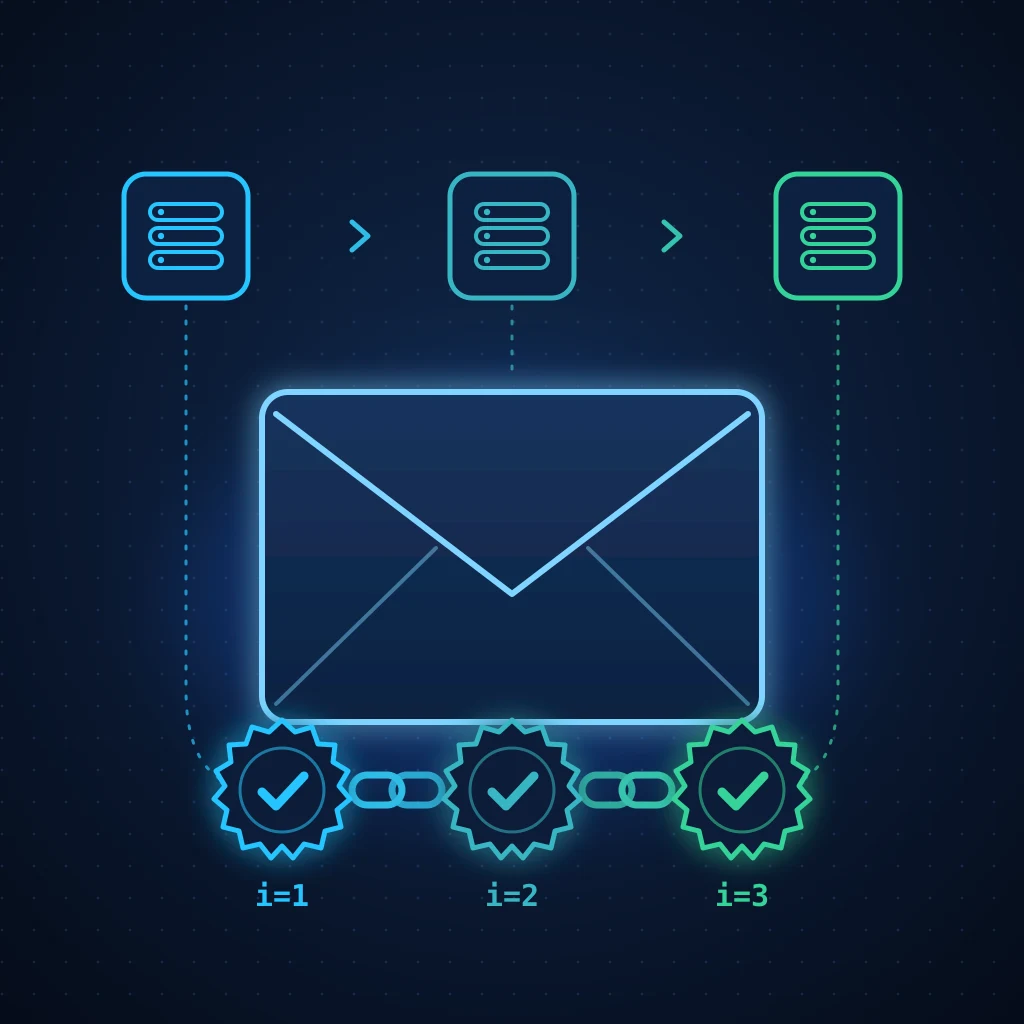
Each hop adds its own numbered signature, so the chain shows who handled the message.
Every system that handles the message adds its own signature. A list accounts for its edits instead of breaking the chain, a copy resent to other recipients stands out, and the draft's stated aim is that bounces go only to systems that took part in the delivery.
What Changes in DNS
Very little. Keys stay in the same TXT record at the same selector name:
Section 3.7 says it directly: “these keys are no different, and are stored in the same locations as those for DKIM1.” What grows is the algorithm list. Verifiers must support RSA-SHA256, Ed25519-SHA256 and ML-DSA-44, a post-quantum scheme. RSA signers should use keys of at least 2048 bits.
What to Do Now
Nothing needs deploying. SPF, DKIM and DMARC still decide where your mail lands. What carries forward is key hygiene: know which selectors you publish, and retire RSA keys under 2048 bits. For the standards that did ship this year, see DMARCbis and RFC 9989.
Check the DKIM keys a domain publishes
DKIM Lookup tests a list of known selectors. Selectors cannot be enumerated, so a custom one is missed.
Look Up DKIM Keys →Sources
- DomainKeys Identified Mail Signatures v2 (DKIM2), draft-ietf-dkim-dkim2-spec-09 — IETF, 1 November 2026. datatracker.ietf.org
- Domain Keys Identified Mail (dkim) working group: charter and milestones — IETF Datatracker, read 29 November 2026. datatracker.ietf.org
Share this article

Manage Your Domain Portfolio in One Place
DNSai Domain Manager — track DNS records, WHOIS expirations, and SPF, DKIM and DMARC status for every domain you own, from one dashboard. Built for teams sitting on dozens or thousands of domains across brands and acquisitions.
Try DNSai Domain ManagerStart at app.dnsai.com — or see what it does first.